
Global Minimum Tax
Global Minimum Tax
Large multinational groups pay a top-up where the effective tax rate in a jurisdiction falls below 15%. The calculation is demanding and the return format unforgiving, so we built our own filing software.
In-house GloBE Information Return preparation software
From jurisdictional effective tax rates through to electronic filing
Safe harbour analysis, top-up tax allocation and validation
What the rules do
The OECD-led international agreement known as Pillar Two, enacted into national law. To stop multinational groups parking profit in low-tax jurisdictions, an effective tax rate is computed for each jurisdiction the group operates in. Where it falls short of 15%, a top-up tax is charged on the difference. Korea has implemented this in the Adjustment of International Taxes Act.
Does it apply to your group?
The rules catch multinational groups with consolidated revenue of EUR 750 million or more in at least two of the four preceding fiscal years, measured on the ultimate parent's consolidated financial statements. Purely domestic groups are outside the scope, but a single constituent entity abroad brings you into scope for review. We can confirm your position from the consolidated accounts.
Where the difficulty lies
The intent is simple; the computation is not. Accounting figures are not used as they stand — they must be adjusted to the GloBE rules.
Recalculated jurisdiction by jurisdiction
For every jurisdiction with constituent entities, GloBE income and adjusted covered taxes are derived to give an effective tax rate. This is not the accounting tax charge.
Safe harbours and exclusions
The de minimis exclusion and the substance-based income exclusion can reduce or remove the top-up. Each condition has to be tested.
Allocating the top-up
Where a top-up arises, it must be allocated across the constituent entities that bear it.
The information return
A prescribed form (the GIR) with a very large number of data points, filed as XML. A single mismatched field produces an error.
So we built the software ourselves
There are too many fields for a spreadsheet, and this is not a one-off filing. We developed our own preparation tool covering everything from the reporting entity details through to the XML export. It validates entries against the form rules before submission, which removes most of the errors that would otherwise come back from the filing system.
- 01
Filing details and group structure
Reporting entity and group information, and the ownership relationships between constituent entities.
- 02
Jurisdictional computation
GloBE income and adjusted covered taxes by jurisdiction, producing the effective tax rate and any top-up.
- 03
Safe harbours and elections
Testing exclusions and applying the available elections.
- 04
Allocation and validation
Allocating across constituent entities, with the tool checking for breaches of the form rules.
- 05
XML export and returns
Generating the submission XML together with the top-up tax return and the reporting on foreign constituent entities.
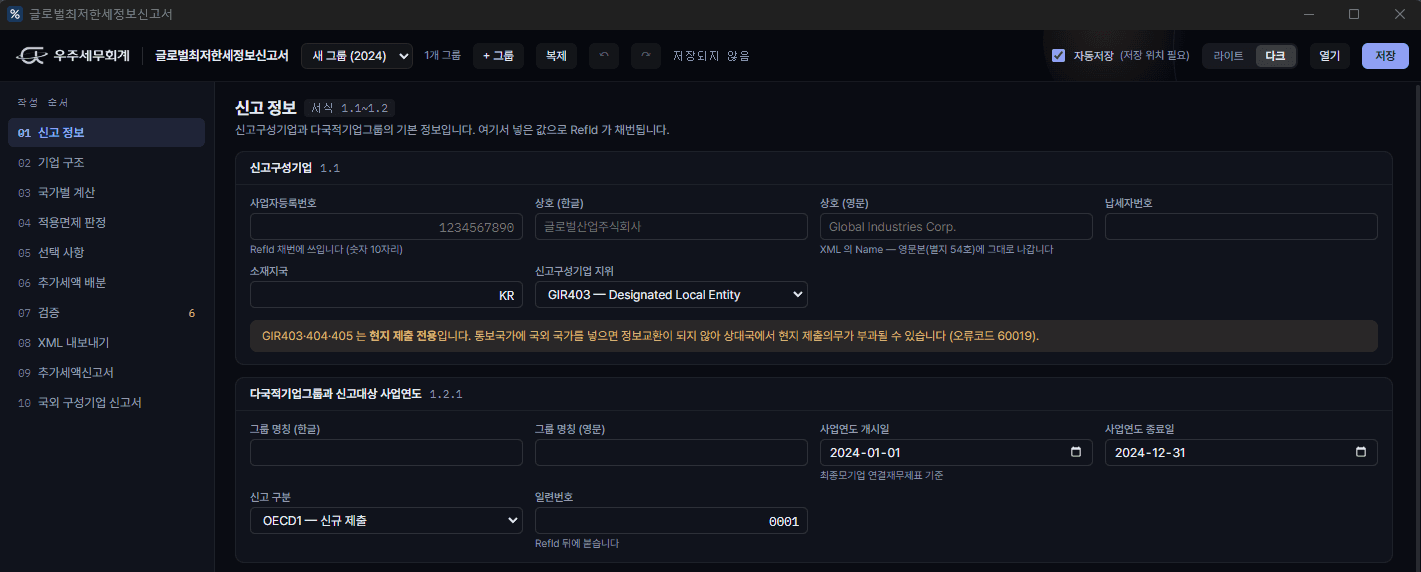
Our own filing preparation software
The screen we work in. The steps on the left run from filing details through to XML submission. Each field shows which form and box it maps to, and combinations that breach the rules are flagged as you enter them.
Scope thresholds, commencement dates and filing deadlines are set by legislation and may change. Your position depends on the group structure and fiscal year, so we confirm applicability and timing at the consultation stage.